
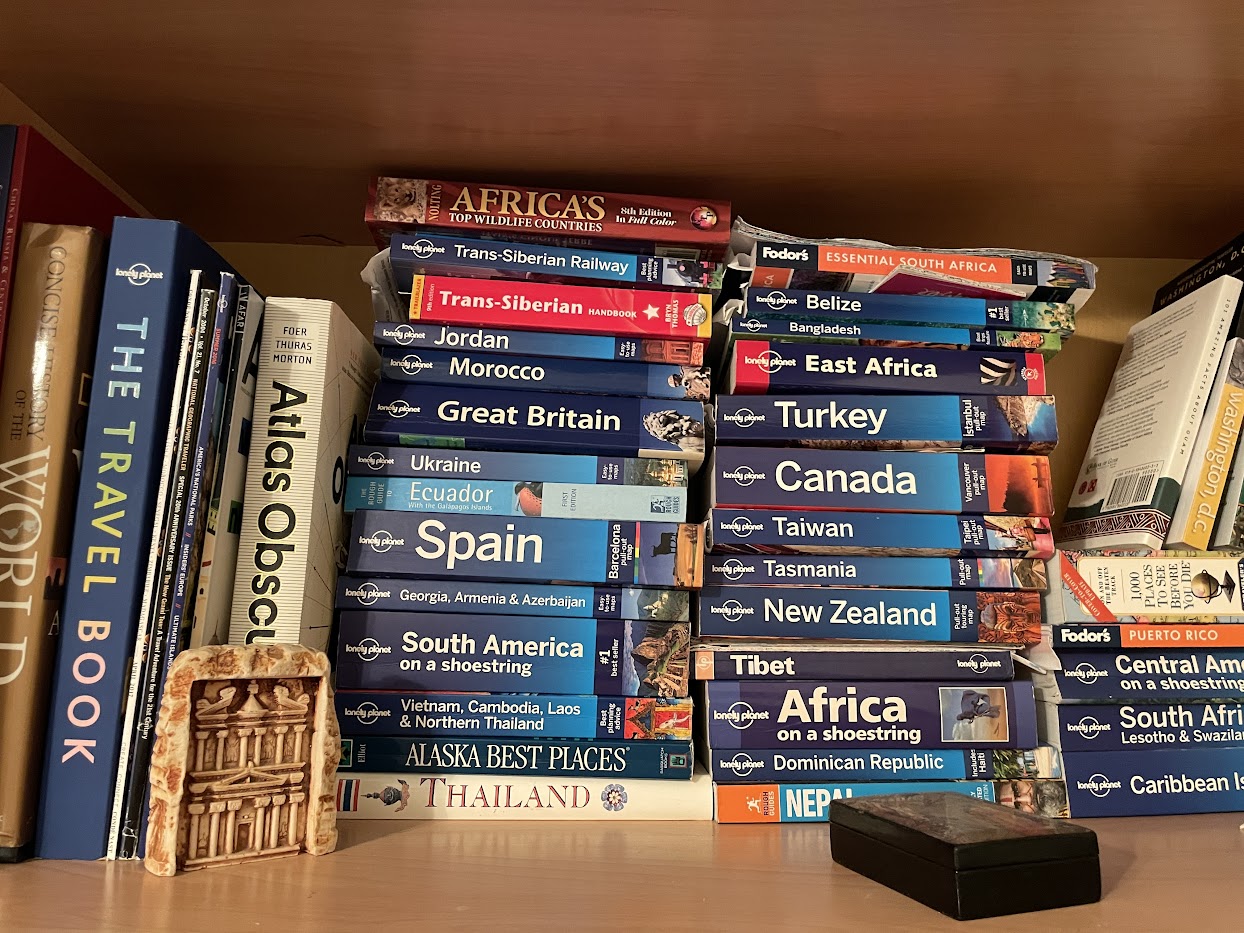
I often hear people say that they don’t know where to get started and that they find researching a trip overwhelming. There are some easy ways to build a personalized independent trip to any location. Here is how I do it…
Guide Book. Despite all of the tools out there, unless I’ve been there before, I start with a guide book. This is a great resource to get a feel for the country. Get to know what the big sites are. Get a feel for how long to spend in each place. Get a feeling for common itineraries for both a country and a city. Etc… For years Lonely Planet has been my go-to. I like the way they are organized. But don’t discount other brands. My mom swears by Fodors. I’ve had success with Bradt and Rough Guides as well. Because you are just getting a feel for a location, you don’t need the latest edition. A used copy from the library or second hand book store is fine.
Tour Companies. I will also look at where tour companies go. I rarely actually take a tour, but I like to see what they include and don’t include. This also helps me determine how long for each place. Because tour companies are dealing with larger groups, add in time for shopping, and tend to have shorter days, I will always shorten my time from what they recommend. You can find tour itineraries online. Also look at more than one company in a range of prices. I will look at GAdventures, Intrepid travel, National Geographic — I also collect some of the larger brochures/books from larger companies. As an example, years ago I picked up several of Audley’s tour books. They organize by continent, so I have three small booklets on my shelf that I reference while planning. Again, they don’t have to be the most current.
You will definitely start to see some overlap – you also might find a couple of hidden gems.
You now have the big picture. You have idea of the famous cities, where you want to go, and in what order. You now take it to the next level. This is where you want current information.
Blogs / Pinterest. Read about other’s experience. Read specific dos / don’ts. Look for common themes about what might be overrated or needs more/less time than usually allowed. You might find interesting tips – as an example, it was from a blog I learned about a hidden staircase in a market in Asia where you could get a bird’s eye view (and photo) of the chaos. Pinterest is also where I went for ideas for a very quick layover in Paris. It was at least my 6th trip to the city, and I only had a few hours, so I needed ideas for easy and flexible things to do in the early morning.
Social Media. Join sites of likeminded people. Ask specific questions. It was through a Facebook question I found my Safari company in South Africa. I also got lots of opinions on a Facebook group about which were the best ruins in Belize… and then I went back to the guidebook to re-read about their suggestions.
Guide Book. Go back to your guide book. What gems did you miss?
You now have a pretty specific list of what you want to do and see.
Specific Websites. Start to fill out the details of your trip by looking up the specific websites of where you are going and doing. Know what days something is closed and the current cost. Piece to together a general order. If something is likely to be booked, buy tickets in advance.
Google Maps or Maps.me. Plot out your activities and start to put it together in an order that make sense. What makes sense to do together? While I love using maps.me in country, the ability to easily switch the order of stops makes me a fan of Google Maps when planning.
Two other thoughts –
Itineraries. I tend to have packed days and a very firm plan before I leave. I know a lot of people resist that much structure. And I think that is fine. But I also am a firm believer that you still need some of the up-front planning. To be truly spontaneous, you need a lot of extra time and money most of us just don’t have when traveling. If you have a general idea of what you want to do then you can have tickets bought if required so you don’t miss it, you know it is closed on Monday so you better go on Saturday or Sunday, you have a backup plan in case of bad weather, or you don’t waste valuable time crisscrossing town every day because you didn’t have an organized route. You don’t have to plan every second. But you don’t want to fly halfway around the world and walk up to a museum to find it closed or eat at McDonalds because you didn’t have a reservation on a Friday night.
Running List I always have a running list of ideas!! I’ll share some specifics in a later post (and it is a little excessive)… But whenever I hear a recommendation about a city, guide, place to eat etc… I write it down. I get these recommendations from everywhere – social media, blogs, fiction and non-fiction books, magazines, podcasts, a stranger in line at the grocery store, a local, fellow travelers, and friends from their trips. It doesn’t matter if I have plans to go there or not. I document it all. I have a spreadsheet with dozens of tabs (43 to be precise). Some are cities, some are countries, some are just regions… This is a great resource when later planning a trip.

 Life Kinetic Travel Research